Showing posts with label sailing. Show all posts

Friday, July 08, 2011

Berehaven To Baltimore

I awoke around 06:30 to find my boat still anchored in Lawrence Cove. Good start! A light breeze is raising light ripples - and is blowing our way. No engine this morning! We weighed anchor under mainsail and jib, washing some reassuringly clingy grey mud from the anchor flukes - ideal holding ground for our anchor.

Soon, the very convenient direction and strength of the wind suggests the notion of raising Briongloid's spinnaker. This gorgeous sail is very definitely the most frightening piece of equipment aboard, rockets and bolt-cutters included. My second best memory of this monster was the time I went forward to douse it; instead I was myself hoisted clear off the foredeck, arms clamped grimly to the starboard (outboard) end of the spinnaker pole, not actually overboard but taking a keen and lively interest in the possibility of returning to the deck at some point in the future.

The channel being broad and calm, with only a wreck or two for hazards, I pulled my old adversary from the forepeak and hoisted the gorgeous rascal. This time, we had a lovely run straight down-channel, our spinnaker submitting quietly to be gybed, and, eventually, doused, as we rounded up to exit Berehaven via its western channel. The lighthouse here has a nice feature: the beacon sends a fan of white light over the whole channel, and a much narrow red beam to show the fairway. When first built, it remained dark for some years. The notion of a lightless lighthouse did not amuse the local skippers, who didn't appreciate having to circumnavigate Bere Island to reach port via the (lit) eastern "man o' war" entrance (much the easier approach for sailing craft), leading to this parliamentary exchange with Baron Ritchie..

A port tack took us out of Bantry Bay and into the open Atlantic, propelled now by mainsail and genoa. A swell coming from the west and refracting around Dursey Island began to rise. As the land shrank astern, the crests rose higher and higher against the green hills on our beam (Sheep Head and Mizen Head), until, from our perspective in their troughs, they swallowed up the land entirely, even (I checked) when I stood on the fore-deck. Disconcerting as it was to be looking up at a wave, these giants were harmless, with a smooth, rounded shape and definitely no breakers.


We tacked in for Mizen Head eventually, crossing tracks with a lone dolphin who didn't stop to play. As we closed with the land, the sun came out and the wind died. Keen to see the landmark familiar from so many shipping forecasts, we came a little too close; replacing fickle wind with faithful engine, we blithely motored straight into the tide race than runs east of the Mizen during a flood tide (clearly shown on Admiralty charts, up to 4 knot currents at spring tides). Here, the wave fronts were short and vicious, and weird vortices betrayed extreme turbulence underneath. No more rising serenely over the summits; Briongloid slammed her bows straight through a particularly vicious specimen, which promptly burst all over the fordeck, passing safely over the anchor locker (well dogged down) and straight through the forehatch (ajar), whence its waters settled comfortably among our cushions and general effects. As the next wave ran eagerly after the first I jumped on the hatch, and remained damply in that position till sea and boat returned to their traditional configuration.

Eventually, normal service resumed. I went below for a doze. We found a whale, who showed no interest in us whatsoever and dived before we could identify it. My helmsman said "the whale is gone". I pointed out the very significance difference between absence of whale and invisibility of whale.


Fastnet Lighthouse (From Bantry to Oysterhaven)

We motored on, beckoned by the rather special Fastnet Light, old and beautiful navigation marker and part-time race buoy. It functions with roughly the same relation to yachts as a moth has to a candle; essentially, the ship killing reef and boiling tide race notwithstanding, it is too beautiful not to approach - two other boats were circling when we arrived.

From Bantry to Oysterhaven
Lot' s Wife, Baltimore

We turned in for Clear Island and Baltimore, passing a drowned calf and, later, cattle grazing on an un-fenced cliff-top by Lot's Wife, a Victorian re-build of a much older marker. We anchored in Baltimore harbour, near a very pretty Cornish Crabber, and ate with friends of my helmsman in a cafe above the harbour. After 13 hours and 70-odd kilometres, sleep came easily.

Wednesday, July 06, 2011

Bantry to Berehaven

On a fine July evening, microlights droned through a summer sky as we loaded Briongloid against the BBSC slipway in a couple of frantic minutes as the ebb tide sucked its way through the perilously thin margin of water below our keel, tossing kit bags, mattresses, ropes, groceries etc straight down the companionway. Then, suddenly, we were free, bow and stern lines back aboard, bow firmly set for open water, the last of the club moorings drifting past.

Windless, we put-putted out to sea, leaving the inner bay through the narrow channel by the airfield where a row of tiny aircraft now sat a-roosting. As Briongloid came abeam of the seal colony south-west of Whiddy Island and began to pitch gently in a faint swell, the chaos of embarkation was gradually resolved into packed lockers and tidy bunks. The sun slid gradually down towards the mountains that make up the backbone of the Beara peninsula, and we began to plot our entry to Berehaven.

As dusk fell, we tracked towards the lighthouse which has blinked its warning since the 19th century, marking the limit of the reefs defining the eastern "Man O'War" entrance to Berehaven. The non-sailor might imagine lighthouses, built as they are on boat-munching reefs, would be something of a deterrent, sending sailors on a wide wreck-averting arc; what is missed from this calculation is that when the sun is gone, the navigator perched in the cockpit of a tiny sailing boat is now afloat in a black void containing innumerable invisible rocks and just one or two with beacons that can easily be identified ten miles off (each having a locally unique sequence of flashes, printed neatly beside them on our excellent Admiralty charts). Being right beside the very well-lit danger gives one the great comfort of being far as possible from the hazards unseen.

I used the last of the daylight to go to Briongloid's tiny foredeck and flake the anchor rode. This procedure involves laying out the chain and rope which will keep the anchor and the boat connected after the former is dropped off the latter. This is an excellent opportunity to inspect the knots and shackles that tie anchor to chain and chain to rope. The bolt closing the second shackle I inspected had almost completely unscrewed itself; I covered its threads in Loctite and closed it up, banking another point in Mr Vigor's leaky black box. Measuring out the rode is actually quite an important job, because the length you need to drop off the bow depends on the depth of water you intend to anchor in: when the wind and tide try to pull your boat away, you want that tug to reach your anchor as a force which is as close to horizontal as possible, tugging its hook into the seabed. Use too little rode, and the wind may raise anchor for you; use too much, and your securely anchored boat may swing into a neighbour - or the shore - as the wind or tide changes.

Night was fully upon us as we entered Berehaven turned into Lawrence Cove, our chosen anchorage. "Haven" comes from the old Norse word höfn - so this cove is a harbour within a harbour, a really excellent place to shelter. One other vessel swung there already, a small ship with lights burning and generators humming. We gave them a wide birth, and dropped our hook, which shot the black water with bright sparks as it felt towards the mud, each little light a tiny animal in fear of our anchor, and attempting to advertise its passing to some larger predator. Not long after, I lay in my bunk and watched through the open companionway hatch some other tiny lights glide silently between the stars: satellites flying far above the shadow of the earth.

I woke once during the night to check our position with a hand bearing compass and sleepy eyes (another point for the black box). We never budged.

Monday, October 04, 2010

Hauling out

Winter haul-out is a melancholy time; the final admission that, this year, there will be no more sailing... no more anchoring in quiet and beautiful places, no random encounters with big beasties from the deep. This winter, Briongloid will get new pintles & gudgeons, and maybe a few electrical tweaks to satisfy her owner's fantasies of hot drinks in cold places.

In compensation for having to leave the water, I did get to participate in the small adventure that is the haul-out. I'm aware that city-folk hire full-time experts who simply crane the vessel straight out of the water and deposit it neatly on a trailer or a stand. Where I grew up, the ritual is practiced in an older and more character-building and ingenuity-testing form, and this last weekend, my Briongloid experienced this form for the first time.

This haul-out went relatively smoothly, but not too smoothly (that would be boring). The local haul-out wizard and myself used van power, muscle power and ultimately an interesting grapnel+outboard engine technique to get the trailer into about 6 feet of water. Briongloid was towed on with an anchor laid out astern to check her way (boats don't have brakes!). Unfortunately, she landed just slightly off-centre on the trailer, missing the trough that normally holds her keel. I did try to fix this (setting a personal speed record for time taken to change into a wet-suit), swimming down to hold the trailer and kick the keel (it has worked before), but she was already too well settled (we had used the van/rope combination to haul the trailer higher on the slip, not a reversible procedure), but ultimately, it was not serious balance problem, and had the advantage of allowing us to clean beneath the keel.

The keel: ah yes. The one part of the boat I couldn't reach to anti-foul before launch. I knew the result would not be pretty, but... wow! After 4 months afloat, the bottom of the keel was encrusted with sea-life. Most prominent were several kilos of mussels - which I seriously considered saving for the pot, until I remembered how close to lots of very toxic paint they had grown. There were also several mysterious animals that were quite transparent - oblong, featureless, with a small yellow structure inside. When squeezed, they squirted. I asked the haul-out wizard their name; he said a local boat man had called them "pissers" - but this wasn't the actual Linnean name. I was amazed to find a relatively large and completely static animal I've never seen before in water I've spent quite a bit of time snorkeling in.

Funny thing about that haul-out: technically, it is mere drudgery, part of the price of owning a sailing boat. This one ate up some hours on a sunny flat-calm Sunday, and involved some moderately heavy manual work, a few good chances to get a nasty crush injury, and at certain points I was cold and wet. Oddly enough, I really enjoyed the whole thing. Water Rat has a point about messing about in boats.

Wednesday, May 20, 2009

The Wrecking of Briongloid


The call came late in the evening from an unfamiliar number; a voice I had never heard before told me that Briongloid (Irish for "dream") was hard aground the rocks outside her home cove. Several hurried phone calls later, I was on the road to the coast, racing through the darkness in convoy with a hastily press-ganged brother-in-law, trying beat the water to our precious boat, and take the salvage opportunity presented by the approaching high tide.

A few miles down the road, the dash was ended by another call; a crew from a local boatyard had got her off. Too late to do any good now, we turned for home.

~


The next day, I saw her. Back on the trailer she had left so recently, her bottom paint still brush-fresh, but her hull now sadly battered, the smooth swell of her hull now sadly gouged and scraped, with cracks that penetrated the hull below the waterline. The rudder, refurbished mere weeks ago, smashed to matchwood, only fragments remaining attached to the gudgeons and the tiller. Inside, the flexing of her hull had cracked the interior. Below, a sinister crack ran right around the keel.

Not good.

Monday, April 06, 2009

Warp Drive

Early on a sunny Saturday afternoon, Briongloid slipped her mooring carrying mainsail, genoa, and a crew of four, and rode a rushing ebb tide into open water; her first proper sail of the season. Sails filled by a gentle force 2-3 from west-north-west, we began our first long tack west, our goal the vast arena of Holeopen Bay some 10km distant - my first proper sailing of the season.

Actually, I have omitted one "sail" from our rig: cut from denim, with an unconvential forked shape, it flew between the spreaders and the mast-top on Briongloid's flag halyard. I mentioned this addition to my (shore-based) wife in a mid-course phone call. On being informed of the current location of her brother's fiancee's trousers (they had been soaked during a lively dinghy transfer), she did not praise my sailorly ingenuity (the hoisting was done with a nifty combination of a snap shackle and a loop in the halyard created with the very wonderful butterfly knot, something I happened to have learnt the previous week). Instead, my wife inquired what, if anything, now covered the nether regions of her brother's "intended".
Proudly, I told her that said regions were well protected, since the lady in question was now wearing my trousers; this didn't reassure my wife quite as much as I expected*.


Hard-wearing and fashionable, denim sails remain a strangely rare sight on racing yachts

The outward trip was unremarkable; a fading wind persuaded me to motor the last km or so, and we dropped anchor where we planned at about the time we expected, in the strange shelter of Holeopen Bay, whose sheer walls rise two hundred feet from the sea. Our course mark was an ancient watchtower perched dramatically at the head of the cliffs, and it was in a small hollow beside that tower than three figures (wives, infant) - impossibly tiny from our anchorage - appeared and waved us a welcome. After a late lunch - which sadly we could not share with the cliff-top watchers - we hoisted the mainsail and prepared to raise anchor.

It was as I moved pull up our anchor that a gust heeled us well to port, sending my brother-in-law (both on the foredeck) scrabbling for handholds; the wind was back, and stronger than before; I immediately amended my choice of foresail to working jib. Once underway, we enjoyed a brief glimpse through headland-traversing tunnels that give the Holeopen Bay its name, then turned to run east for home. The jib did little for us on this point of sail, and the Voice of Temptation began to whisper seductive suggestions; I cast a thoughtful gaze across the great blue sweep of sea about us, sizing up the frequency of the white caps which had begun to appear, the level of the chop. Then, I put a veteran dinghy sailor on the helm, briefed a veteran kayaker with iron forearms on the controlling of "kites", and assigned a near-novice sailor to help me on the foredeck.

Well, down came the jib, and up went the spinnaker, the huge mass of coloured fabric filling the sky above me as I crouched beneath it on the rolling foredeck. At first, it only half filled; then we dropped the mainsail, and Briongloid surged forwards. I have to admit that I was far from certain of a positive result - to a non-racer like myself, spinnakers are broach-inducing monsters, and my crew-briefing concentrated mostly on broach-avoidance and broach-survival. Briongloid, however, remained upright, and the great walls of Holeopen Bay shrank away with unprecedented speed, as our bow opened a long white gash across blue-black water. From bow to stern, we exchanged huge smiles. Briongloid's hull fairly sang now; she seemed to have donned seven-league boots. Faster and faster we went, our speed building until we began to surf.

It seemed too good to last; but it did last, and we rode that wind home on spinnaker alone, right to the cove mouth, a golden evening of fast and thrilling sailing with a crew of good friends, racing across an empty sea for nothing but the joy of it, a sail I'm likely to remember for some time.

The final turn to enter the cove required downing the magical spinnaker, my new favourite sail; but down it would not come. Inspection showed the halyard had a twist or two about the forestay. We let fly the leeward sheet to de-power our colourful, wonderful monster, but the wind still kept too much pressure aloft to let us get our sail back. To maintain steerageway, I had my crew raise the mainsail - and suddenly, the pressure eased, and down came the spinnaker. I'm thinking that the mainsail sheltered the spinnaker, easing the tension on the halyard. The working jib was still hanked on, so was raised again in moments, and soon we were sliding gently back into the river mouth, boat hook raised and ready.

* Wet trousers are a common calamity when dinghy transfers are as long and boisterous as ours tend to be; a cheerfully oblivious attitude to beating straight through tide races has contributed its share of wettings, too. I now make it a habit to carry at least one full change of clothes plus "emergency towel" in a dry bag, and it was these spares that I loaned out; it is a bit early in the spring for trouser-less sailing.

Wednesday, February 04, 2009

Sinking, Part 3

Being the third installment of a tale of a watery tale begun here and continued here.

At last, Briongloid was safely on her trailer. On a snowy afternoon, I left The City early to go the boatyard and get a look the problem from the outside. I love the approach to the boatyard: it lies near the navigable limit of a tree-lined river - very scenic. This time, the tide was low, and some very interesting boats were sitting high and dry in the mud. The channels deep enough to carry Briongloid are narrow, sinuous, and unmarked.

Once at the yard, diagnosing the problem didn't take very long at all; on her starboard side, well below the waterline, an ancient mechanical log (its display long since lost) protrudes from her hull. For non-boating folk, a log is a device for measuring a boat's speed through the water; the earliest logs actually were logs, or at least splinters. Since I carry a hand-held GPS, and always (so far!) sail in sight of land (so can take bearings with a hand compass), a log is not really an essential item - especially since, like most skippers, I can usually estimate my boat's speed quite accurately. When I had last seen the log, its protruding arm carried a small propeller which turned as the water flowed past, the rotation being carried into the hull by a wire rotating within an outer protective sheath.

The Leak

Since then, as the photo shows, something had ripped that little propeller clear of its mount, exposing the core, and pulling the base of the instrument loose. Looking at the damage, I was amazed poor Briongloid had survived - the damage looked absolutely frightening, exactly the sort of thing that persuaded me to leave damage control plugs next to all through-hull fittings. Looks like the through-hulls which feed and empty her sea toilet are innocent after all - but what did I hit? A guilty memory of the time I snagged my own mooring bouy sidles into my mind's eye...


After a quick chat with the owner of the boatyard, we had a repair plan: I would get the boat as dry as I could, and put on a tarp (low-skilled work, suitable for a bungling boat owner). A de-humidifier will be left inside to dry her further, sucking every possible drop from her bilges, fittings, even the hull itself. Then, a nice man from the yard who knows what he is doing will drill out all remains of the log, and glass over the resulting gaping hole, fairing the repair with epoxy. Finally (we hope), we'll drop Briongloid back in the river, and see if she still floats...

As the sun went down, I began a long, long list of boat-related jobs, loading my long-suffering car with things to fix and things to dry ( soaking sails, soaking cushions, hatch covers, wash boards, a rudder, etc.) . I also spent quite a lot of time down in the bilges with pumps and a sponge. Ah, the glamorous life of the yachtie!

The afternoon sun had melted what little snow lay on Briongloid's deck; later, as the sun set, and I scrambled about the decks with pointy tools, measuring tape, and tarpaulin, the water turned quickly to ice. I found skating up and down her decks to be a highly disconcerting experience; on her trailer, she is a tall boat, and I didn't fancy the drop. Extra respect to all you high-latitude sailors - how on earth do you manage to stay on board when your boats are not only ice-covered, but moving?

Venus was brilliant between the snow-clouds by the time the last knots on tarp were secure. This far up-river, most yard inhabitants are low-draught motor launches, fat and squat, with a sprinkle of lifting-keel pocket cruisers, and our boat stood out; in the cool light of the half-moon, the silhouette of an enshrouded Briongloid looked tall, sleek, fast, and a little bit mysterious.

Squeezing myself into the driver's seat, tucking my head below a wandering tiller (still attached to a rudder that my boot would barely close on), I left her to the night.

Monday, January 26, 2009

Sinking, Part 1

Briongloid was always a wet boat; ever since I launched her, pumping her bilges has been a regular pre-sail ritual. On overnight stays, I got used to pumping out in the mornings. Every now and then, I would work my way around her deck, looking for weaknesses and blasting them with sealant. Bucket-testing proved I was making progress, although oddly, her bilges didn't get any drier.

After a couple of years of pretty regular sea-faring - and equally regular pumping - I selfishly left Briongloid entirely unvisited for two months or more , til an e-mail forwarded by a friend of a friend told me all was not well...

Briongloid - heavier by 2000+ litres

He was right. As my dinghy skipped across the inlet, my heart sank further and further. Boarding her felt very strange; although logic told me that another 70 kilos should not sink her, an older part of my brain took one look at her freeboard and engage "fight or flight". My first act was to - very gingerly - inch up to the foredeck to see what difference my weight would make to her attitude in the very worse-case scenario. A boat this length (just under 22ft) shifts slightly under her crew's weight, which never bothered me before - I trust my keel; this time, every tiny shift in balance seemed like an opener to a death-plunge.

Logic was right; so an immediate sinking was out. I pulled out the wash boards (a kind of door into the cabin, for non-sailors) and horrified - if not very surprised - to see that water had filled her as high as her bunks. It was my great luck, though, that although the sea had already claimed cushions, charts, tools, it had not reached - by about an inch - the battery that powers all things electrical aboard Briongloid. Very, very gingerly, I got the battery to a place of relative safety. Then, I rigged up the electrical bilge pump that I hadn't quite got around to permanently installing, and watched order return to the cabin. Fifty minutes and above 2000 litres of seawater later, the pump sucked dry - but not before I had gingerly tasted the flood. Salt water.
Oh dear.

In a fibreglass boat, sea water really doesn't have a lot of routes into the hull. Unlike, say, a wooden boat, the hull material itself is continuous - no seams. Typically, the hull will have a few piercings, though - in Briongloid's case, several bolts for her fin keel (with about 440 kg of ballast down there, having lots of bolts is nice), and also two thru-hulls for a loo I had installed. Now, one of these had nearly killed her - but which one?


~

I ran the electric pump till the remaining water was too low to reach; then, I got a little further with a manual pump. After that, I rigged up a pretty hair-raising contraption involving Briongloid's battery, an inverter, and a tiny water pump intended for a desk-based fountain. Finally, I actually sponged up every remaining puddle that could be reached. With the bilge as dry as I could make it, I retired to the cockpit, and spent an hour or so admiring the view - which, it has to be said, is pretty fine (house prices around here are - or were - just over the million euro mark - quite a few orders of magnitude above the price of Briongloid and her mooring). At the end of my hour. a puddle had collected in little fibreglass pocket below the loo's thru-hulls, and I was practically jumping for joy. There is a leak, yes - but it is fixable.

~

Briongloid
having had an automatic bilge pump rigged, my mind was at ease again; I put-putted across the inlet in perfect serenity an hour or so after sunset, and nature's mood matched mine, with the waters almost spooky-still, and just a hint of mist in the frosty air. The blackness around me was pierced only by warm windows of the cove's few houses, and the brighter heavenly bodies - like Capella, a bright beacon above the invisible slipway, and Venus, putting on a fine show high above the silent forest. The winter sky is a beautful thing.


Coming up next: off to the boatyard.

Sunday, November 23, 2008

Whale Patrol

Day-dreams of craggy headlands, taut canvas, wide blue horizons - clearly, I was in the grip of a bad case of sea-fever. The fever was not reduced by a steady stream of reports that huge beasts were on the move just off-shore. This far north, the sun sinks early, and gales are frequent; I would have to wait my chance.

I found a Saturday with a weather window just wide enough to slip through (framed by gales); found a willing crew (Mr. H); and so, arrived at a deserted slipway at dawn to launch my dinghy into the teeth of a nor'wester whose brisk chop delivered a bucket or two of seawater into the dinghy before by the time we reached Briongloid.

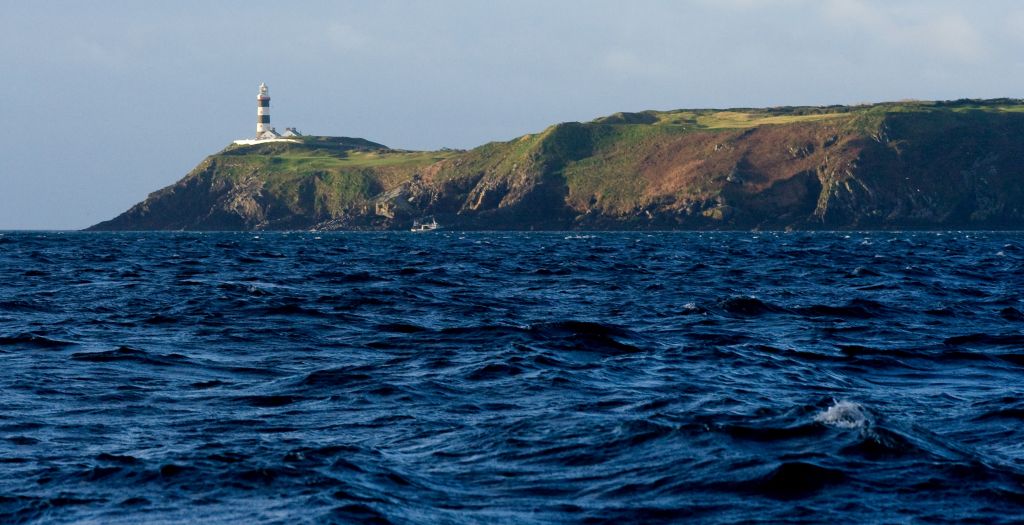
With only a modest set of sail, Briongloid fairly leapt along under a mostly-blue sky, across an empty sea - not another mast to be seen; we steered south west to bring us close by the Old Head. We could have dodged south to escape the tide race generated by the flood coming east around the Old Head of Kinsale, but the gold of the early sun on the craggy cliffs and the lighthouse tempted us within convenient photographic range. We knew the tide race when we met it: Briongloid's bows buried to the deck, and a certain skipper dogged the forehatch down tight in a hurry...

The Old Head about an hour after dawn (Picture: D. Hoberg)

The pounding of the tide race was short-lived, and soon we were around the headland, beating across the white-capped chop of Courtmacsherry Bay; a good wind, force 5 to 6. Three hours out, investigations of circling sea birds - gannets, mostly - lead us to our first sighting, a brief glimpse of a common dolphin no more than 10 or 15 metres dead ahead. Mr. H missed it; not long after, I saw a patch of mist hang in the air 50-70 metres or so ahead - gone again a moment later. Did I imagine it? Within a few tens of seconds, I had my answer: another whale-breath misted into the air, and a huge black back showed for a moment before vanishing once more into the depths - straight towards us - almost certainly a Minke whale.

There is something uniquely heart-pounding about encounters with the mega-fauna of this planet, something beyound the sheer physical bulk, a thing that is absent in mere scenery; perhaps it is the sense of an encounter between human and non-human minds... that we look at a beast, and the beast looks back. Now, in the cold blue vastness beneath us, something huge and wild moved unseen; but though we turned and searched, and turned again, our whale escaped us.

Not long after, a small pod of common dolphins moved across the bow; too close for co-incidence, I think. Mr. H saw them this time, but they moved off to windward, and dived; perhaps they just surfaced to take a look at us? We searched on, sailing into the easternmost extent of Clonakilty Bay, with the white gleam of the hotel showing above the strand. Then the clock told us it was time to turn, and we tacked for home, taking our lunch a few km south of Seven Heads - hot tomato soup, very welcome on a cold winter day.

The final incident of the day came when a bottle neck screw vanished from a stay on the leeward side - I really have to get hold of some seizing wire. Luckily, I had a replacement, and got it fitted while Mr. H paid especially close attention to keeping a steady course. Not so luckily, we heeled well over, a sea stole on deck and crept inside my waterproofs, soaking me to the knees. That gave me a real problem: I was wearing jeans, and the cotton wicked the water steadily up my legs; by the time I was finished fixing and checking rigging screws, I began to shiver, and my speech to slur, and my mind to get a little foggy. Hypothermia is an isidious enemy. I dried off my feet, keeping them bare, then layered up, and wedged myself into the (comparitively) cosy corner of the fore-peak while Mr. H stood watch alone.

Right on schedule, we slipped into the cove against an ebbing tide as the sun dipped below the horizon, saluting a feeding seal as we came, and tacked onto the mooring as a huge flock of crows swept in a black gyre low over the woods and the river mouth; from the east, more dark wings swept by in squadrons, until thousands swirled above us, and the twilight echoed with their cries. Well might they huddle in their roosts: their worst enemies fly by night.

Day's run: about 65km, in 8 hours, almost entirely under sail (GPS track on Google Maps).

Important Lesson: wear hydropobic synthetics only - and bring a change of clothes, no matter how good your outer layer is.

Sunday, June 15, 2008

Landing Party

By way of rounding off a weekend of preparing a certain Mr. B to enter married life, I put to sea on a Sunday afternoon with a full crew - of my three brothers-in-law, plus Mr. B himself. Sailing in the lightest of airs, my crew made a neat job of tacking their way out the mouth of the inlet to open water, while I orbited them in Briongloid's dinghy, shouting helpful advice and snapping pictures.

With no particular object in mind, we wandered slowly out from the land... until a large rock - "Little Sovereign" - caught our collective imaginations. An excellence chance to demonstrate anchoring: the rode was flaked, the anchor laid, the sails dropped, and a landing party dispatched to claim the barren rock.

Three of us made a shore party: we picked a cove-in-miniature, then changed our minds at the last second when the suck and surge of the swell made our prospective landing spot seem more like a good place for a wrecking; instead, we chose a set of natural steps in the rock, as safe and easy a landing spot as any steep piece of rock covered in weeds and mussels could be. For all the times I've cursed the rowing characteristics of inflatables, sometimes it is very, very nice to have a hull that bounces instead of denting or splitting.


Briongloid lies at anchor, as seen from the summit of Little Sovereign

The island itself is shaped from a sedimentary rock with very well-defined planes. These are warped and bent from ancient pressures, and slope at about 30 degrees into the sea, so that the whole island, viewed end-on, appears to have developed a serious list. The summit lies on a dramatic ridge, with a very sheer drop to seaward, while the landward side is a little friendlier - a single uninterrupted sloping slab of smooth rock. I stood for a while at the summit precipice, drinking in the view - the dramatic cliffs of the mainland to my north, Briongloid toy-like at anchor below me, the great sweep of the open ocean to the south. Climbed carefully down again, back to the dinghy and my waiting friends, and tucked the memory away for safe-keeping.

We will return...

Tuesday, June 03, 2008

Through the Head

We slipped our mooring early on a foggy Saturday, motoring on a sea as slick and smooth as silk. Outside the cove, we steered into blank fog, trusting to GPS. We were not the first to sea, however - the surface was thick with birds a-fishing, and I glimpsed the fin of a hunting dolphin. A long line of tall masts loomed out of the murk: yachts in a line, racing in slow-motion, inching out to open water in the slackest conceivable wind. By the time we dropped anchor in the great cliff-lined bight of Holeopen Bay, our inflatable canoes were rigged and ready to launch. Festooned with torches, light-sticks and cameras, we abandoned Briongloid. Soon, a little flotilla of two canoes and a dinghy paddled off to the foot of the mighty sea-cliffs which define Holeopen Bay.

Beneath the Old Head of Kinsale

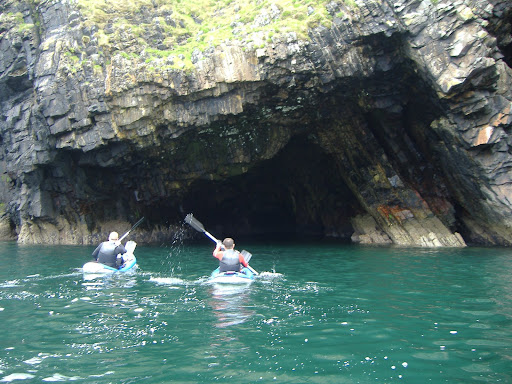
Using an ancient ruined tower on the cliff-tops as a guide, we soon found what we were looking for: the entrance to tunnels which pass clear through the Old Head of Kinsale, running east-west from Holeopen Bay to Courtmacsherry Bay. The first tunnel was a little narrow, but the second had a large and welcoming entrance. Inside the cave - surprisingly well lit - we soon began to feel the up/down motion of the swell, amplified by the funnel-shape of the entrance. Progress along the narrowing tunnel was good, until the last fifteen or so metres, when Mr T ran the lead canoe hard aground on a barely-submerged boulder. No sooner was the problem announced, when a roar from behind me announced the solution - and a breaking wave lifted me well above Mr T before launching me forward into his back and blasting us both well clear of the obstruction.

A second wave followed the first, and soon we were both capsized, grabbing in the darkness for boats and paddles, and bracing for the next breaker. Turning, I saw Mr. J approaching in Briongloid's dinghy, the tunnel so narrow that he had to paddle with a single oar. I shouted a warning just as he ran aground. Just then, the next breaker reared behind him, before breaking over the dinghy. A good time to send the dinghy back... I waited in the blackness and the crashing of the waves until the dinghy was safely on its way.

Choosing a tunnel

My swimming fins being already on my feet, I turned my face to the light, and covered the last few metres into Courtmacsherry Bay as a swimmer, pushing my kayak and paddle before me. The western side of the headland was just as dramatic as I remembered - even taller and steeper cliffs, and a huge sea-stack covered in nesting birds. Big grins from me and Mr. T - a long time since we'ld first attempted the transit, and great to be finally through. We found a second tunnel - much wider - and a little hairy paddling later, were safely back in Holeopen Bay, and boarding Briongloid, ready for our lunch.

By now, the sun had burnt the fog from the water and a gentle breeze had got up; we weighed anchor under sail and tacked out around the Old Head of Kinsale under a perfect summer sky. Angler's boats dotted the water, and helicopters circled the lighthouse on the headland - a really spectacular backdrop. Tacking gently southward with main and genoa, we moved out to sea, hoping for a sighting of a Minke whale, or perhaps a Basking Shark. We spent the rest of the afternoon on a single tack, moving gently on the clear blue water of the open ocean as the coast behind us diminished to a smudge on the horizon. Dinner was served about 19:00, by which point we were about 19km almost due south of Oysterhaven - within a mile or two of the grave of the Lusitania; time to jibe for home, and work north as the summer sun sank slowly towards the land. Picking up our mooring just after sunset, our distance for the day was 54km aboard Briongloid under power and sail, and perhaps another 2km in canoes and dinghies.

Sunday, May 25, 2008

Bird of Passage

Working on Briongloid's foredeck on a sunny Saturday afternoon, I was in the perfect position to watch the arrival of a sleek low double-ended boat I didn't recognise, coming in the from the open sea with only a singly scrap of sail still flying. At her tiller sat a man in full foul-weather gear who waved a salute as he sailed by up-river. As I worked, I saw the red hull work a few hundred metres up-stream, well clear of the moorings, and drop anchor.

The Ness Yawl "Rat" anchored in the Belgooly river

A little later, I saw a white shape appear above the hull: through binoculars, I saw that an awning had been rigged, using the main mast as a ridgepole. A cruiser then... I hopped in the dinghy, and put-putted over to say hello.

The sleek red shape I'ld been admiring turned out to be a Ness Yawl, a two-masted open boat of about 22ft LOA designed in the double-ended style of a Norwegian Faering by Iain Oughtred, a boat architect from the Isle of Skye. This beautifully-finished example of its type had been built by its owner, Robin, an allegedly amateur boat builder. A slightly stretched version of the original plans, the good boat "Rat" had just been sailed from the vicinity of Fishguard across the Irish Sea to Tramore, and hence, propelled by an easterly gale, to Oysterhaven, in the course of a few hours of particularly intense sailing - lively going, in an open boat. At least, with such a wind, her lack of an engine was no hindrance...

Robin turned out to be a returning visitor to these waters, having cruised these bays several times before, both for pleasure in his own 27ft wooden yacht, and as skipper of a 90ft super yacht - also of traditional design. Robin is well-supplied with good sailing stories, having previously cruised his own engine-less yacht to New Zealand and back (out across the Atlantic, through the Panama canal, across the South Pacific to New Zealand, and home around Cape Horn). This summer, he is taking the diminutive Rat on a cruise of indefinite duration, to waters undecided.

Talking to Robin gave me an even worse case of Sea Fever than I already had. Lucky, then, that I'm due to catch the ebb-tide this coming Friday for a voyage to points westward...