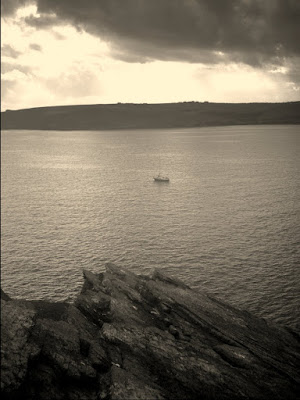
Windless, we put-putted out to sea, leaving the inner bay through the narrow channel by the airfield where a row of tiny aircraft now sat a-roosting. As Briongloid came abeam of the seal colony south-west of Whiddy Island and began to pitch gently in a faint swell, the chaos of embarkation was gradually resolved into packed lockers and tidy bunks. The sun slid gradually down towards the mountains that make up the backbone of the Beara peninsula, and we began to plot our entry to Berehaven.
As dusk fell, we tracked towards the lighthouse which has blinked its warning since the 19th century, marking the limit of the reefs defining the eastern "Man O'War" entrance to Berehaven. The non-sailor might imagine lighthouses, built as they are on boat-munching reefs, would be something of a deterrent, sending sailors on a wide wreck-averting arc; what is missed from this calculation is that when the sun is gone, the navigator perched in the cockpit of a tiny sailing boat is now afloat in a black void containing innumerable invisible rocks and just one or two with beacons that can easily be identified ten miles off (each having a locally unique sequence of flashes, printed neatly beside them on our excellent Admiralty charts). Being right beside the very well-lit danger gives one the great comfort of being far as possible from the hazards unseen.
I used the last of the daylight to go to Briongloid's tiny foredeck and flake the anchor rode. This procedure involves laying out the chain and rope which will keep the anchor and the boat connected after the former is dropped off the latter. This is an excellent opportunity to inspect the knots and shackles that tie anchor to chain and chain to rope. The bolt closing the second shackle I inspected had almost completely unscrewed itself; I covered its threads in Loctite and closed it up, banking another point in Mr Vigor's leaky black box. Measuring out the rode is actually quite an important job, because the length you need to drop off the bow depends on the depth of water you intend to anchor in: when the wind and tide try to pull your boat away, you want that tug to reach your anchor as a force which is as close to horizontal as possible, tugging its hook into the seabed. Use too little rode, and the wind may raise anchor for you; use too much, and your securely anchored boat may swing into a neighbour - or the shore - as the wind or tide changes.
Night was fully upon us as we entered Berehaven turned into Lawrence Cove, our chosen anchorage. "Haven" comes from the old Norse word höfn - so this cove is a harbour within a harbour, a really excellent place to shelter. One other vessel swung there already, a small ship with lights burning and generators humming. We gave them a wide birth, and dropped our hook, which shot the black water with bright sparks as it felt towards the mud, each little light a tiny animal in fear of our anchor, and attempting to advertise its passing to some larger predator. Not long after, I lay in my bunk and watched through the open companionway hatch some other tiny lights glide silently between the stars: satellites flying far above the shadow of the earth.
I woke once during the night to check our position with a hand bearing compass and sleepy eyes (another point for the black box). We never budged.