Day-dreams of craggy headlands, taut canvas, wide blue horizons - clearly, I was in the grip of a bad case of sea-fever. The fever was not reduced by a steady stream of reports that huge beasts were on the move just off-shore. This far north, the sun sinks early, and gales are frequent; I would have to wait my chance.
I found a Saturday with a weather window just wide enough to slip through (framed by gales); found a willing crew (Mr. H); and so, arrived at a deserted slipway at dawn to launch my dinghy into the teeth of a nor'wester whose brisk chop delivered a bucket or two of seawater into the dinghy before by the time we reached Briongloid.
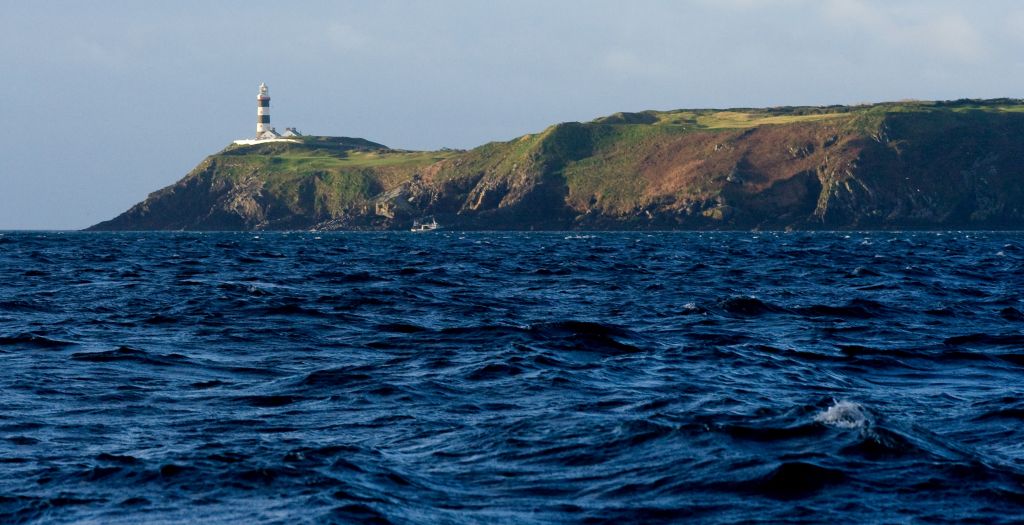
With only a modest set of sail, Briongloid fairly leapt along under a mostly-blue sky, across an empty sea - not another mast to be seen; we steered south west to bring us close by the Old Head. We could have dodged south to escape the tide race generated by the flood coming east around the Old Head of Kinsale, but the gold of the early sun on the craggy cliffs and the lighthouse tempted us within convenient photographic range. We knew the tide race when we met it: Briongloid's bows buried to the deck, and a certain skipper dogged the forehatch down tight in a hurry...
The pounding of the tide race was short-lived, and soon we were around the headland, beating across the white-capped chop of Courtmacsherry Bay; a good wind, force 5 to 6. Three hours out, investigations of circling sea birds - gannets, mostly - lead us to our first sighting, a brief glimpse of a common dolphin no more than 10 or 15 metres dead ahead. Mr. H missed it; not long after, I saw a patch of mist hang in the air 50-70 metres or so ahead - gone again a moment later. Did I imagine it? Within a few tens of seconds, I had my answer: another whale-breath misted into the air, and a huge black back showed for a moment before vanishing once more into the depths - straight towards us - almost certainly a Minke whale.
There is something uniquely heart-pounding about encounters with the mega-fauna of this planet, something beyound the sheer physical bulk, a thing that is absent in mere scenery; perhaps it is the sense of an encounter between human and non-human minds... that we look at a beast, and the beast looks back. Now, in the cold blue vastness beneath us, something huge and wild moved unseen; but though we turned and searched, and turned again, our whale escaped us.
Not long after, a small pod of common dolphins moved across the bow; too close for co-incidence, I think. Mr. H saw them this time, but they moved off to windward, and dived; perhaps they just surfaced to take a look at us? We searched on, sailing into the easternmost extent of Clonakilty Bay, with the white gleam of the hotel showing above the strand. Then the clock told us it was time to turn, and we tacked for home, taking our lunch a few km south of Seven Heads - hot tomato soup, very welcome on a cold winter day.
The final incident of the day came when a bottle neck screw vanished from a stay on the leeward side - I really have to get hold of some seizing wire. Luckily, I had a replacement, and got it fitted while Mr. H paid especially close attention to keeping a steady course. Not so luckily, we heeled well over, a sea stole on deck and crept inside my waterproofs, soaking me to the knees. That gave me a real problem: I was wearing jeans, and the cotton wicked the water steadily up my legs; by the time I was finished fixing and checking rigging screws, I began to shiver, and my speech to slur, and my mind to get a little foggy. Hypothermia is an isidious enemy. I dried off my feet, keeping them bare, then layered up, and wedged myself into the (comparitively) cosy corner of the fore-peak while Mr. H stood watch alone.
Right on schedule, we slipped into the cove against an ebbing tide as the sun dipped below the horizon, saluting a feeding seal as we came, and tacked onto the mooring as a huge flock of crows swept in a black gyre low over the woods and the river mouth; from the east, more dark wings swept by in squadrons, until thousands swirled above us, and the twilight echoed with their cries. Well might they huddle in their roosts: their worst enemies fly by night.
Day's run: about 65km, in 8 hours, almost entirely under sail (GPS track on Google Maps).
Important Lesson: wear hydropobic synthetics only - and bring a change of clothes, no matter how good your outer layer is.
Showing posts with label oysterhaven. Show all posts
Showing posts with label oysterhaven. Show all posts
Sunday, November 23, 2008


Sunday, June 15, 2008
Landing Party
By way of rounding off a weekend of preparing a certain Mr. B to enter married life, I put to sea on a Sunday afternoon with a full crew - of my three brothers-in-law, plus Mr. B himself. Sailing in the lightest of airs, my crew made a neat job of tacking their way out the mouth of the inlet to open water, while I orbited them in Briongloid's dinghy, shouting helpful advice and snapping pictures.
With no particular object in mind, we wandered slowly out from the land... until a large rock - "Little Sovereign" - caught our collective imaginations. An excellence chance to demonstrate anchoring: the rode was flaked, the anchor laid, the sails dropped, and a landing party dispatched to claim the barren rock.
Three of us made a shore party: we picked a cove-in-miniature, then changed our minds at the last second when the suck and surge of the swell made our prospective landing spot seem more like a good place for a wrecking; instead, we chose a set of natural steps in the rock, as safe and easy a landing spot as any steep piece of rock covered in weeds and mussels could be. For all the times I've cursed the rowing characteristics of inflatables, sometimes it is very, very nice to have a hull that bounces instead of denting or splitting.
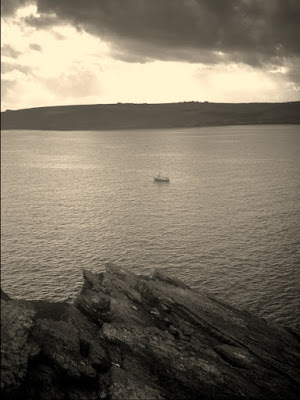
The island itself is shaped from a sedimentary rock with very well-defined planes. These are warped and bent from ancient pressures, and slope at about 30 degrees into the sea, so that the whole island, viewed end-on, appears to have developed a serious list. The summit lies on a dramatic ridge, with a very sheer drop to seaward, while the landward side is a little friendlier - a single uninterrupted sloping slab of smooth rock. I stood for a while at the summit precipice, drinking in the view - the dramatic cliffs of the mainland to my north, Briongloid toy-like at anchor below me, the great sweep of the open ocean to the south. Climbed carefully down again, back to the dinghy and my waiting friends, and tucked the memory away for safe-keeping.
We will return...
With no particular object in mind, we wandered slowly out from the land... until a large rock - "Little Sovereign" - caught our collective imaginations. An excellence chance to demonstrate anchoring: the rode was flaked, the anchor laid, the sails dropped, and a landing party dispatched to claim the barren rock.
Three of us made a shore party: we picked a cove-in-miniature, then changed our minds at the last second when the suck and surge of the swell made our prospective landing spot seem more like a good place for a wrecking; instead, we chose a set of natural steps in the rock, as safe and easy a landing spot as any steep piece of rock covered in weeds and mussels could be. For all the times I've cursed the rowing characteristics of inflatables, sometimes it is very, very nice to have a hull that bounces instead of denting or splitting.
Briongloid lies at anchor, as seen from the summit of Little Sovereign
The island itself is shaped from a sedimentary rock with very well-defined planes. These are warped and bent from ancient pressures, and slope at about 30 degrees into the sea, so that the whole island, viewed end-on, appears to have developed a serious list. The summit lies on a dramatic ridge, with a very sheer drop to seaward, while the landward side is a little friendlier - a single uninterrupted sloping slab of smooth rock. I stood for a while at the summit precipice, drinking in the view - the dramatic cliffs of the mainland to my north, Briongloid toy-like at anchor below me, the great sweep of the open ocean to the south. Climbed carefully down again, back to the dinghy and my waiting friends, and tucked the memory away for safe-keeping.
We will return...
Tuesday, June 03, 2008
Through the Head
We slipped our mooring early on a foggy Saturday, motoring on a sea as slick and smooth as silk. Outside the cove, we steered into blank fog, trusting to GPS. We were not the first to sea, however - the surface was thick with birds a-fishing, and I glimpsed the fin of a hunting dolphin. A long line of tall masts loomed out of the murk: yachts in a line, racing in slow-motion, inching out to open water in the slackest conceivable wind. By the time we dropped anchor in the great cliff-lined bight of Holeopen Bay, our inflatable canoes were rigged and ready to launch. Festooned with torches, light-sticks and cameras, we abandoned Briongloid. Soon, a little flotilla of two canoes and a dinghy paddled off to the foot of the mighty sea-cliffs which define Holeopen Bay.
 Beneath the Old Head of Kinsale
Using an ancient ruined tower on the cliff-tops as a guide, we soon found what we were looking for: the entrance to tunnels which pass clear through the Old Head of Kinsale, running east-west from Holeopen Bay to Courtmacsherry Bay. The first tunnel was a little narrow, but the second had a large and welcoming entrance. Inside the cave - surprisingly well lit - we soon began to feel the up/down motion of the swell, amplified by the funnel-shape of the entrance. Progress along the narrowing tunnel was good, until the last fifteen or so metres, when Mr T ran the lead canoe hard aground on a barely-submerged boulder. No sooner was the problem announced, when a roar from behind me announced the solution - and a breaking wave lifted me well above Mr T before launching me forward into his back and blasting us both well clear of the obstruction.
A second wave followed the first, and soon we were both capsized, grabbing in the darkness for boats and paddles, and bracing for the next breaker. Turning, I saw Mr. J approaching in Briongloid's dinghy, the tunnel so narrow that he had to paddle with a single oar. I shouted a warning just as he ran aground. Just then, the next breaker reared behind him, before breaking over the dinghy. A good time to send the dinghy back... I waited in the blackness and the crashing of the waves until the dinghy was safely on its way.
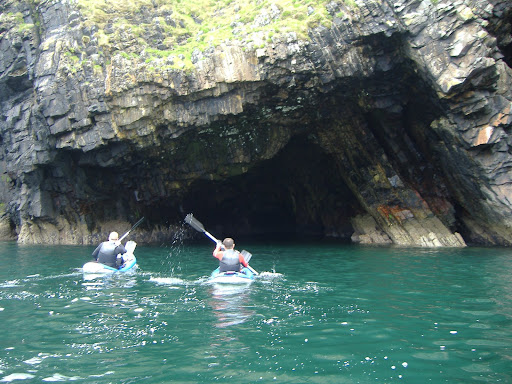 Choosing a tunnel
My swimming fins being already on my feet, I turned my face to the light, and covered the last few metres into Courtmacsherry Bay as a swimmer, pushing my kayak and paddle before me. The western side of the headland was just as dramatic as I remembered - even taller and steeper cliffs, and a huge sea-stack covered in nesting birds. Big grins from me and Mr. T - a long time since we'ld first attempted the transit, and great to be finally through. We found a second tunnel - much wider - and a little hairy paddling later, were safely back in Holeopen Bay, and boarding Briongloid, ready for our lunch.
By now, the sun had burnt the fog from the water and a gentle breeze had got up; we weighed anchor under sail and tacked out around the Old Head of Kinsale under a perfect summer sky. Angler's boats dotted the water, and helicopters circled the lighthouse on the headland - a really spectacular backdrop. Tacking gently southward with main and genoa, we moved out to sea, hoping for a sighting of a Minke whale, or perhaps a Basking Shark. We spent the rest of the afternoon on a single tack, moving gently on the clear blue water of the open ocean as the coast behind us diminished to a smudge on the horizon. Dinner was served about 19:00, by which point we were about 19km almost due south of Oysterhaven - within a mile or two of the grave of the Lusitania; time to jibe for home, and work north as the summer sun sank slowly towards the land. Picking up our mooring just after sunset, our distance for the day was 54km aboard Briongloid under power and sail, and perhaps another 2km in canoes and dinghies.
 Beneath the Old Head of Kinsale
Using an ancient ruined tower on the cliff-tops as a guide, we soon found what we were looking for: the entrance to tunnels which pass clear through the Old Head of Kinsale, running east-west from Holeopen Bay to Courtmacsherry Bay. The first tunnel was a little narrow, but the second had a large and welcoming entrance. Inside the cave - surprisingly well lit - we soon began to feel the up/down motion of the swell, amplified by the funnel-shape of the entrance. Progress along the narrowing tunnel was good, until the last fifteen or so metres, when Mr T ran the lead canoe hard aground on a barely-submerged boulder. No sooner was the problem announced, when a roar from behind me announced the solution - and a breaking wave lifted me well above Mr T before launching me forward into his back and blasting us both well clear of the obstruction.
A second wave followed the first, and soon we were both capsized, grabbing in the darkness for boats and paddles, and bracing for the next breaker. Turning, I saw Mr. J approaching in Briongloid's dinghy, the tunnel so narrow that he had to paddle with a single oar. I shouted a warning just as he ran aground. Just then, the next breaker reared behind him, before breaking over the dinghy. A good time to send the dinghy back... I waited in the blackness and the crashing of the waves until the dinghy was safely on its way.
Choosing a tunnelMy swimming fins being already on my feet, I turned my face to the light, and covered the last few metres into Courtmacsherry Bay as a swimmer, pushing my kayak and paddle before me. The western side of the headland was just as dramatic as I remembered - even taller and steeper cliffs, and a huge sea-stack covered in nesting birds. Big grins from me and Mr. T - a long time since we'ld first attempted the transit, and great to be finally through. We found a second tunnel - much wider - and a little hairy paddling later, were safely back in Holeopen Bay, and boarding Briongloid, ready for our lunch.
By now, the sun had burnt the fog from the water and a gentle breeze had got up; we weighed anchor under sail and tacked out around the Old Head of Kinsale under a perfect summer sky. Angler's boats dotted the water, and helicopters circled the lighthouse on the headland - a really spectacular backdrop. Tacking gently southward with main and genoa, we moved out to sea, hoping for a sighting of a Minke whale, or perhaps a Basking Shark. We spent the rest of the afternoon on a single tack, moving gently on the clear blue water of the open ocean as the coast behind us diminished to a smudge on the horizon. Dinner was served about 19:00, by which point we were about 19km almost due south of Oysterhaven - within a mile or two of the grave of the Lusitania; time to jibe for home, and work north as the summer sun sank slowly towards the land. Picking up our mooring just after sunset, our distance for the day was 54km aboard Briongloid under power and sail, and perhaps another 2km in canoes and dinghies.
Subscribe to:
Posts (Atom)