Less than a week on dry land, and I was missing salt water already - so left the office early, a colleague in tow - Mr. G. After a slightly damp dinghy transfer across the cove, we were tumbling aboard Briongloid and losing no time in rigging her for open water.
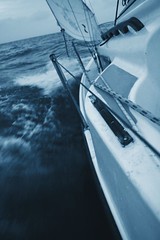
As we cleared the sheltering land, we felt her rise on the swell rolling in from the south west. Her sails filling then, the rising burble from her stern was almost musical. As the light faded from another grey autumn evening, Briongloid cut smoothly south and west into the rising waves, alone on an empty ocean.
Friday, September 21, 2007


Wednesday, September 12, 2007
Escort
An (adapted) extract from the log recording Briongloid's first cruise
On the last morning, I raised anchor at 08:00, rescuing two very bewildered starfish from the chain as I gathered it in. With the storm jib already set, Briongloid bore off a little and began to move as soon as the anchor cleared the bottom; I had already lashed the tiller amidships, and she "self-steered" very smoothly out into Courtmacsherry Bay as I finished my jobs on the foredeck.
Before the morning was out, the cliffs of the Old Head slid past - the final headland was cleared, and a few miles ahead, the bulk of Big Sovereign marked our home cove. Just then, I spotted black fins in the water off the port bow.
 Dolphin surfacing in Briongloid's wake
I bore up a little to meet them, and was thrilled to see the fins turn and slice towards me.
Within seconds, Briongloid was at the center of the school, and looking down from her cockpit, I could see sleek shapes streaking along beside her, a metre or two below the surface. Every few seconds, a fin would break the surface as a dolphin caught its breath; and sometimes, a muscular body would arc completely clear of the water. The dolphins stayed with me for a kilometre or so, playing all around while I scrambled to get a clear photo; then, two rose into the air side by side, landed with a neat double splash, and headed east; one by the one, the rest of my escort broke off to follow them.
On the last morning, I raised anchor at 08:00, rescuing two very bewildered starfish from the chain as I gathered it in. With the storm jib already set, Briongloid bore off a little and began to move as soon as the anchor cleared the bottom; I had already lashed the tiller amidships, and she "self-steered" very smoothly out into Courtmacsherry Bay as I finished my jobs on the foredeck.
Before the morning was out, the cliffs of the Old Head slid past - the final headland was cleared, and a few miles ahead, the bulk of Big Sovereign marked our home cove. Just then, I spotted black fins in the water off the port bow.
 Dolphin surfacing in Briongloid's wake
I bore up a little to meet them, and was thrilled to see the fins turn and slice towards me.
Within seconds, Briongloid was at the center of the school, and looking down from her cockpit, I could see sleek shapes streaking along beside her, a metre or two below the surface. Every few seconds, a fin would break the surface as a dolphin caught its breath; and sometimes, a muscular body would arc completely clear of the water. The dolphins stayed with me for a kilometre or so, playing all around while I scrambled to get a clear photo; then, two rose into the air side by side, landed with a neat double splash, and headed east; one by the one, the rest of my escort broke off to follow them.
Friday, September 07, 2007
Briongloid's First Cruise: Encounter with a Giant
From "Briongloid"'s log for Thursday, August 25th
Raised anchor in Baltimore Harbour at 10:00 and slid gently out past "Lot's Wife" with full main and genoa set. Once outside the lee of Cape Clear, good westerly helped me to progress eastward, running almost dead down-wind with sails goose-winged, easy sailing under a clear blue sky, the sun bright enough to make me cover my hands for fear of their burning. The wicked-looking Stag Rocks (nemesis of the "Kowloon Bridge") drifted past very satisfactorily to port, and I allowed my course to take Briongloid well clear of the land.
By late afternoon, however, the easy progress of the morning was forgotten. Speed fell away, until an uncanny calm came over the water, and the sails hung slackly by the mast; after a week of light northerly airs, even the swell was undetectable. Four miles out, the land looked low and distant; the water was very, very clear and blue, and, just then, glassy and inviting. It was immensely quiet.
At 18:00, I had just decided to abandon all pretense of steering a motionless boat and break for dinner when I heard a deep "whoosh" to the south; a glance revealed the source to be a very large whale indeed. By the time I had my camera at the ready, I was too late: the giant's black back arched gently above the surface just once - then the weirdly small fin slid back under the surface, and beast dove deep.
 Briongloid at Midnight, Broadstrand Bay
Just 5 minutes later, the long-promised strong north-westerlies arrived, and Briongloid was making 9 to 10 kph towards Seven Heads. The wind built quickly, and within the hour, I realised that I was over-canvassed. Foolishly, I decided against leaving the helm to drop the genoa, instead managing the steeply-heeling boat by luffing the mainsail. After two hours of fast sailing, I entered Courtmacsherry Bay just as the sun sank below the hills. Time to stop for the night; my charts showed a perfect spot close by - Broadstrand Bay, the perfect depth, and well-sheltered - though not so sheltered as to disable a boat totally reliant on sail power.
It was about this time that I discovered the damage two hours of luffing could do - the vibration had shaken loose the body of a bottleneck screw which attached a lee-ward stay to the deck. The genoa was doused in record time, and a temporary repair effected; then, reading my chart by torchlight and steering my moonlight and GPS, I tacked gingerly past the Horse rock in the gloom of early night, and dropped anchor right in the middle of Broadstrand Bay. The falling chain blazed eerily as it sank through the water: phospherence, very strong. The run for the day was 68 kilometres, made over 12 hours of single-handed sailing.
Raised anchor in Baltimore Harbour at 10:00 and slid gently out past "Lot's Wife" with full main and genoa set. Once outside the lee of Cape Clear, good westerly helped me to progress eastward, running almost dead down-wind with sails goose-winged, easy sailing under a clear blue sky, the sun bright enough to make me cover my hands for fear of their burning. The wicked-looking Stag Rocks (nemesis of the "Kowloon Bridge") drifted past very satisfactorily to port, and I allowed my course to take Briongloid well clear of the land.
By late afternoon, however, the easy progress of the morning was forgotten. Speed fell away, until an uncanny calm came over the water, and the sails hung slackly by the mast; after a week of light northerly airs, even the swell was undetectable. Four miles out, the land looked low and distant; the water was very, very clear and blue, and, just then, glassy and inviting. It was immensely quiet.
At 18:00, I had just decided to abandon all pretense of steering a motionless boat and break for dinner when I heard a deep "whoosh" to the south; a glance revealed the source to be a very large whale indeed. By the time I had my camera at the ready, I was too late: the giant's black back arched gently above the surface just once - then the weirdly small fin slid back under the surface, and beast dove deep.
 Briongloid at Midnight, Broadstrand Bay
Just 5 minutes later, the long-promised strong north-westerlies arrived, and Briongloid was making 9 to 10 kph towards Seven Heads. The wind built quickly, and within the hour, I realised that I was over-canvassed. Foolishly, I decided against leaving the helm to drop the genoa, instead managing the steeply-heeling boat by luffing the mainsail. After two hours of fast sailing, I entered Courtmacsherry Bay just as the sun sank below the hills. Time to stop for the night; my charts showed a perfect spot close by - Broadstrand Bay, the perfect depth, and well-sheltered - though not so sheltered as to disable a boat totally reliant on sail power.
It was about this time that I discovered the damage two hours of luffing could do - the vibration had shaken loose the body of a bottleneck screw which attached a lee-ward stay to the deck. The genoa was doused in record time, and a temporary repair effected; then, reading my chart by torchlight and steering my moonlight and GPS, I tacked gingerly past the Horse rock in the gloom of early night, and dropped anchor right in the middle of Broadstrand Bay. The falling chain blazed eerily as it sank through the water: phospherence, very strong. The run for the day was 68 kilometres, made over 12 hours of single-handed sailing.
Thursday, September 06, 2007
To Trail's End
The final episode of the "Back Country" serial post
Our night at Mystic Camp was punctuated by long rumbling peals of thunder, and fat rain drops drumming on the canvas above us. By the time we woke, though, the weather was clearing up; and when we rode out, the sun was shining again - though invisible to us, riding now along a densely-forested valley floor. This was the easiest riding by far, covering a short distance on the widest and easiest trails of our journey. We broke for lunch in a clearing below the gloriously named Mount Fifi (very fine-looking peak, actually).
 Riders at Mt. Norquay, Canadian Rockies
And then, we were back, the familiar mountain-scape around Banff opening up in front of us, riding through meadows that in winter become pistes. Nature had one more surprise for us before trail's end, though; trotting nonchalantly past only forty or so metres away came a coyote - the first I'ld ever seen.
Back at the corral, our guide was effusively thanked, and (we hope) generously tipped. If you'ld like to see something of the Canadian backcountry, you might think of dropping a line to Warner Outfitters, Banff.
Our night at Mystic Camp was punctuated by long rumbling peals of thunder, and fat rain drops drumming on the canvas above us. By the time we woke, though, the weather was clearing up; and when we rode out, the sun was shining again - though invisible to us, riding now along a densely-forested valley floor. This was the easiest riding by far, covering a short distance on the widest and easiest trails of our journey. We broke for lunch in a clearing below the gloriously named Mount Fifi (very fine-looking peak, actually).
 Riders at Mt. Norquay, Canadian Rockies
 And then, we were back, the familiar mountain-scape around Banff opening up in front of us, riding through meadows that in winter become pistes. Nature had one more surprise for us before trail's end, though; trotting nonchalantly past only forty or so metres away came a coyote - the first I'ld ever seen.
Back at the corral, our guide was effusively thanked, and (we hope) generously tipped. If you'ld like to see something of the Canadian backcountry, you might think of dropping a line to Warner Outfitters, Banff.
Wednesday, August 15, 2007
In the Back Country: the ride to Mystic
Continued from "to Flint's Peak" and "Into the Back Country"
We woke to another beautiful Rocky Mountain morning - to blue skies and the fresh smells of the dewy meadow and the surrounding pines. Back on the trail, a detour and a short walk along a rather exposed path brought us to the exceptional North Cascade Falls - a real gem of a waterfall in a gorgeous little canyon.
Back on the horses, our ride took us past a shuttered Park Warden's cabin - as a supplementary precaution against ursine intrusion, large numbers of nails had been hammered upwards through wooden pallets, and these left in front of all doors and windows. The location was pretty perfect - right beside a river, with a neat-as-a-pin corral alongside (including a chute to allow horses to drink straight from the river). Lucky people.
 North Fork Cascade Falls
Fording the Cascade River for the last time, we rode up the crest of a steep and very exposed ridge - an arete, really. The views on this ascent were probably very good - but the author was too busy dizzying himself by looking down the precipitous drops to either side to pay much attention to the wider landscape. Fortunately for the future of this blog, Ajax behaved himself almost perfectly.
The ridge topped out into level ground eventually, and short stroll through trees brought us to the western shore of Rainbow Lake - a classic post-glacial feature, sitting in a high bowl with steep rocky sides, the shale still concealed in places by the last of the winter's snowdrifts. Perhaps a thousand feet above, mountain sheep were silhouetted briefly against the sky. In the lake at our feet, trout surfaced continuously. To add the final touch of wildness and beauty to the scene, an Osprey stooped down from the trees on the north shore, splashed once, then climbed with impressive speed to circle past us, a dripped trout wriggling in his talons.
We rode on; steeply downhill, and onto the broad open spaces of Forty Mile Pass, which sits on the old packer route between Banff and Jasper, and gives exceptional views to north and south. Then, down again, past a circling eagle, and into the forest, and at last into Mystic Camp.
 Campfire at Mystic
It was at Mystic that we were introduced by the camp packer to the mysteries of the great Austrialian art of whip-cracking. This is done with a fantastically supple fifteen foot leather whip, which tapes slowly to a very light and narrow tip. The easiest way to get the crack out is to start by laying the whip straight ahead; then, a surprisingly slow and gentle pull on the handle lifts the leather up and back past the whipper's ear - after which the handle is brought smartly forward, accelerating the tip of the tip to Mach 2! This doesn't produce the crack - but the loop that has just been induced in the main body does, shooting down the thinning leather, concentrating the energy into an ever-lighter cross section, and finally breaking the sound-barrier. Done right, this sounds just like a rifle - and, when you think about it, the sound is generated in a very similar way. Done wrong, I found the thong very likely to wind up around my neck, on the back of my legs, or really anywhere I did not mean it to be. The evening ended around the campfire, with our guide and packer trading trail stories.
We woke to another beautiful Rocky Mountain morning - to blue skies and the fresh smells of the dewy meadow and the surrounding pines. Back on the trail, a detour and a short walk along a rather exposed path brought us to the exceptional North Cascade Falls - a real gem of a waterfall in a gorgeous little canyon.
Back on the horses, our ride took us past a shuttered Park Warden's cabin - as a supplementary precaution against ursine intrusion, large numbers of nails had been hammered upwards through wooden pallets, and these left in front of all doors and windows. The location was pretty perfect - right beside a river, with a neat-as-a-pin corral alongside (including a chute to allow horses to drink straight from the river). Lucky people.
 North Fork Cascade Falls
Fording the Cascade River for the last time, we rode up the crest of a steep and very exposed ridge - an arete, really. The views on this ascent were probably very good - but the author was too busy dizzying himself by looking down the precipitous drops to either side to pay much attention to the wider landscape. Fortunately for the future of this blog, Ajax behaved himself almost perfectly.
The ridge topped out into level ground eventually, and short stroll through trees brought us to the western shore of Rainbow Lake - a classic post-glacial feature, sitting in a high bowl with steep rocky sides, the shale still concealed in places by the last of the winter's snowdrifts. Perhaps a thousand feet above, mountain sheep were silhouetted briefly against the sky. In the lake at our feet, trout surfaced continuously. To add the final touch of wildness and beauty to the scene, an Osprey stooped down from the trees on the north shore, splashed once, then climbed with impressive speed to circle past us, a dripped trout wriggling in his talons.
We rode on; steeply downhill, and onto the broad open spaces of Forty Mile Pass, which sits on the old packer route between Banff and Jasper, and gives exceptional views to north and south. Then, down again, past a circling eagle, and into the forest, and at last into Mystic Camp.
 Campfire at Mystic
Friday, August 10, 2007
In the Back Country: on to Flint's Peak
Continued from "Into the Back Country"
On our second day, C rode out on a fresh mount, the very handsome Ricky - her previous mount, Gent, was being given an easy day, on account of having been bitten by Ajax while in the corral. Ricky was very lazy, always falling behind - until motivated with a freshly-cut switch, after which he became a reformed character.
We rode first along a winding trail through dark forest, tall pines close on every side. Once, we passed a ruined log cabin, built by trappers sometime around the start of the twentieth century. The walls still stood, but the massive trunks of falling trees had toppled inwards from all sides to crash through the roof; an imaginative observer might think the forest had sacrificed a few of its giants to drive the intruders out.
Dark forest became scrubby bog, followed by meadow; we sat a while beside an old elk trap, used to thin (by relocation) the local population. Later, we stopped for lunch in a forest whose floor was carpeted with the thickest and softest mosses became the mattresses for our siesta; we dozed beside an abandoned wolf den, under the solemn gaze of a young and fearless owl.
 Fording the Cascade River
The afternoon ride was a little more challenging; we rode a very narrow trail across a steep slope, listening to loose stones rattle off into the forest below. I felt Ajax stumble once or twice, but my Appaloosa didn't fail me. Later, he took me safely through the cold, cold Cascade River a time or two (stirrup-deep, sometimes), and finally, very cautiously, down the break-neck steepness of the trail into our camp below Flint's Peak.
 Camped below Flint's Peak
In camp, I took to the river to wash away the heat and grime of the trail; my chosen bathtub was a hollow in mid-river in the lee of an obstruction that broke the current. I reached it by edging out along some fallen trees, a very rough and slippery bridge, trying not to think about how it would feel to be swept downstream after a good raking from the sharp stumps of broken branches. It was the coldest (and easily the quickest) bath of my life - but what a location.
On our second day, C rode out on a fresh mount, the very handsome Ricky - her previous mount, Gent, was being given an easy day, on account of having been bitten by Ajax while in the corral. Ricky was very lazy, always falling behind - until motivated with a freshly-cut switch, after which he became a reformed character.
We rode first along a winding trail through dark forest, tall pines close on every side. Once, we passed a ruined log cabin, built by trappers sometime around the start of the twentieth century. The walls still stood, but the massive trunks of falling trees had toppled inwards from all sides to crash through the roof; an imaginative observer might think the forest had sacrificed a few of its giants to drive the intruders out.
Dark forest became scrubby bog, followed by meadow; we sat a while beside an old elk trap, used to thin (by relocation) the local population. Later, we stopped for lunch in a forest whose floor was carpeted with the thickest and softest mosses became the mattresses for our siesta; we dozed beside an abandoned wolf den, under the solemn gaze of a young and fearless owl.
 Fording the Cascade River
The afternoon ride was a little more challenging; we rode a very narrow trail across a steep slope, listening to loose stones rattle off into the forest below. I felt Ajax stumble once or twice, but my Appaloosa didn't fail me. Later, he took me safely through the cold, cold Cascade River a time or two (stirrup-deep, sometimes), and finally, very cautiously, down the break-neck steepness of the trail into our camp below Flint's Peak.
 Camped below Flint's Peak
In camp, I took to the river to wash away the heat and grime of the trail; my chosen bathtub was a hollow in mid-river in the lee of an obstruction that broke the current. I reached it by edging out along some fallen trees, a very rough and slippery bridge, trying not to think about how it would feel to be swept downstream after a good raking from the sharp stumps of broken branches. It was the coldest (and easily the quickest) bath of my life - but what a location.
Thursday, August 02, 2007
Encounter
I knew I was close - lots of fresh scat on the ground, seed-stippled, each heap with its own orbiting cloud of flies, the stink competing for my attention with the pervading reek of rotten fish. Turning a corner, I sent a cloud of scavenging ravens flapping into the sky; the eagles remained, unmoving but watchful of my passing. There were pug-marks in the mud, broad game-trails in the grass. Perhaps the bear was gone - or perhaps he was behind me. After three hours of stalking, that nasty eyes-on-the-back-of-my-neck feeling was stronger that ever, and my hand hovered above the holster on my hip.
I decided on one final pass through the thicket before giving up - having already seen the runs and the fish scraps, I knew that he must spend a lot of time there. Leaving open ground was a risky tactical move, though. In the thicket, I could pass right by whole squadrons of bears without ever realizing - and a pounce could bring me down before I could even draw, let alone aim.
Then, something clicked in my awareness, and 15 yards ahead, the dark shape framed by the bushes snapped into focus. Glossy black fur framed intelligent eyes that looked directly at me. For an instant, the bear and I stared at each other. His head was disconcertingly big and high. Being face to face with a large carnivore of uncertain intention concentrates the mind perfectly. The yard, the stink, even the surrounding thicket, all vanished, leaving nothing but overwhelming awareness of bear.
Before I could raise either camera or my Capsaicin-based spray, he turned- and, immediately, vanished in the thicket. I would hate to inadvertently trap a nervous bear in a confined space; I circled the thicket once, very, very warily. Then I gave up. I have no video; but I have found my bear.
I decided on one final pass through the thicket before giving up - having already seen the runs and the fish scraps, I knew that he must spend a lot of time there. Leaving open ground was a risky tactical move, though. In the thicket, I could pass right by whole squadrons of bears without ever realizing - and a pounce could bring me down before I could even draw, let alone aim.
Then, something clicked in my awareness, and 15 yards ahead, the dark shape framed by the bushes snapped into focus. Glossy black fur framed intelligent eyes that looked directly at me. For an instant, the bear and I stared at each other. His head was disconcertingly big and high. Being face to face with a large carnivore of uncertain intention concentrates the mind perfectly. The yard, the stink, even the surrounding thicket, all vanished, leaving nothing but overwhelming awareness of bear.
Before I could raise either camera or my Capsaicin-based spray, he turned- and, immediately, vanished in the thicket. I would hate to inadvertently trap a nervous bear in a confined space; I circled the thicket once, very, very warily. Then I gave up. I have no video; but I have found my bear.
Subscribe to:
Posts (Atom)